Did God really say, “You will surely die” (תָּמוּת מוֹת)? Do you know the answer to that question? Do you know where it came from? It wasn’t Christmas or Easter. But the failure to correctly answer that question led to our need for Christmas and Easter. And some other things.

Do you only go to church on Christmas and Easter? For many, Christmas and Easter are the two things you celebrate because they represent God’s plan for saving us from our sins. Aren’t they? Are they the days that get you into Heaven? If so, you’re not alone. But really, they’re only part of the story.
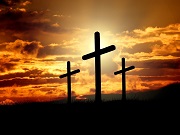
First, a quick word about the image for this one. I asked for two different scenes in one image. At first, I wasn’t going to use any of them. I reworded the request, to make the desire for two completely different scenes clearer. I even described the scene outside the empty tomb where Jesus was laid after the crucifixion. The results were even worse.
So I decided to stay with this one.
Why? I mean, it’s just so wrong!
And it is. But it’s also sad, because it’s indicative of the kinds of stuff the image generator was “trained” on. There apparently is so much wrong stuff out there on Easter, aka “Resurrection Day”, that it gave me an image of Good Friday, the Day Jesus was crucified on the cross. And even then, it merged the two, even though I specified two different scenes.
That’s a sad commentary on the state of the information out there on the web for someone who doesn’t know about these three important Christian days. How is anyone supposed to learn what’s right, with all the junk out there? And who put it there?
Maybe this series on God’s plan for the salvation of His people is even more important than I thought.
Summary
Delves into the nuanced interpretation of the biblical phrase “you will surely die,” examining its implications beyond the literal sense and how it connects to the broader narrative of salvation.
God’s Command to Adam: discusses the biblical account of God commanding Adam not to eat from the tree of knowledge of good and evil, with the consequence of death (תָּמוּת מוּת) for disobedience.
Translation Variations: highlights the differences in translations of the Bible, emphasizing that English versions are not the original word of God but interpretations of Hebrew or Greek texts.
Death Interpretation: examines the Hebrew תָּמוּת מוּת phrase sometimes interpreted as “dying thou dost die” or “you will surely die” and suggests it may imply both a physical and spiritual death, rather than a simple repetition for emphasis.
Salvation and Resurrection: reflects on the Christian belief in resurrection and eternal life through Jesus, suggesting that understanding the full context of biblical events like the Fall is crucial for faith.
In conclusion, the intricate analysis of scriptural language presented here invites us to reflect on the multifaceted nature of spiritual teachings, encouraging a deeper understanding of the divine plan that unfolds from Genesis to the Resurrection.
Why is salvation needed?
Many people may say that we need salvation because we sinned against God. Maybe “the fall” gets added to that. Some, wrongly, will say something about Adam and Eve eating the forbidden apple in the Garden of Eden.
As I pointed out, one of those answers is wrong. All of them are something less than the complete truth. You may remember, from Perry Mason or some such TV show, the importance of telling the truth, the whole truth, and nothing but the truth. I know, that’s not done so much anymore. But it really is important. After all, even Satan tells partial truths.
What were Adam and Eve told to not do?
As soon as we ask something like ” What were Adam and Eve told to not do?”, we’re making some assumptions. As Perry Mason would say, those are facts entered without evidence!
For instance:
- Do we know that Adam and Eve were actually told anything? (see below)
- Do we know that either of them from forbidden to do something? (coming in the next segment of this series)
Let’s take a look at those two things. Most people will likely say “yes” to both of them.
Do we know that Adam and Eve were actually told anything?
We do know that Adam was told something. And that he was told by God. What was Adam told? What we think Adam was told depends on which Bible translation we read.
For instance, in the 1984 NIV that I tend to use as the default here, it says:
Adam and Eve
…
Ge 2:15 The LORD God took the man and put him in the Garden of Eden to work it and take care of it. 16 And the LORD God commanded the man,
…
So, God told Adam something. We’ll get to what God said in a moment.
The thing is, we aren’t told who told Eve. It may have been God. Or, maybe it was Adam. We just don’t know.
I feel like it’s usually significant when some seemingly important detail gets left out. It’s not like God forgot to tell the author, Moses. But why?
Well, again, we can’t know for sure. But, many times when something gets left out, it feels like it’s to prevent us from putting something “in a box”.
For instance, if God told Eve, then we can assume it wasn’t Adam’s fault when Eve was tricked. We could blame God for not explaining it properly. Or we could blame Eve for not listening well enough.
But then, if Adam told Eve, then God’s off the hook, and the explanation/listening issue remains, but with Adam and Eve, rather than God and Eve.
But we aren’t told. We can’t blame anyone. And that’s a good thing. Why? Because, as we learn later in the Bible, there’s not a single one of us who could’ve come away from the scenario with the serpent and avoided the temptation to eat from the tree.
What did God tell Adam? – you will surely die
Let’s put verse 15 back, along with the remainder of the statement from God.
Ge 2:15 The LORD God took the man and put him in the Garden of Eden to work it and take care of it. 16 And the LORD God commanded the man, “You are free to eat from any tree in the garden; 17 but you must not eat from the tree of the knowledge of good and evil, for when you eat of it you will surely die.”
The question now is this: what does that mean?
Many of us learn, from a variety of sources, that God forbade Adam from eating from the tree of knowledge of good and evil. But – is that correct?
The Bible is inerrant, it’s the word of God, so it must be true, right? Sorry, but our English translations of the Bible are not God’s word. They are translations, with some interpretation, of something. If they came from the original Hebrew (in this case) or Greek, then they came from God’s word. But if they were translated from, say English to Chinese, then neither of them is God’s word.
Here are those same verses, but this time from Young’s Literal Translation, where the English most closely resembles, word for word, the original Hebrew.
Ge 2:16 And Jehovah God layeth a charge on the man, saying, ‘Of every tree of the garden eating thou dost eat; 17 and of the tree of knowledge of good and evil, thou dost not eat of it, for in the day of thine eating of it—dying thou dost die.’ 1
Look what it says at the end: “dying thou dost die” — not “you will surely die”
What’s going on? Well, here’s another look at the passage, with the Hebrew words underneath the corresponding words in the 2010 NIV English translation, which says certainly rather than surely.

Notice – the English text says “you will certainly (surely) die.
And yet, there are only two Hebrew words. Both are Strong’s #4191. The word is repeated.
Many times when something is repeated in the Bible, that’s to show it will definitely happen. But then, that’s also usually a phrase, a sentence, a complete event. This is one word.
Maybe we can consider death enough of an event to make the repeating word formula valid, even though it is just one word.
Now, let’s see what shows up for 4191.
4191 מוּת [muwth /mooth/] v. A primitive root; TWOT 1169; GK 4637; 835 occurrences; AV translates as “die” 424 times, “dead” 130 times, “slay” 100 times, “death” 83 times, “surely” 50 times, “kill” 31 times, “dead man” three times, “dead body” twice, “in no wise” twice, and translated miscellaneously 10 times. 1 to die, kill, have one executed. 1A (Qal). 1A1 to die. 1A2 to die (as penalty), be put to death. 1A3 to die, perish (of a nation). 1A4 to die prematurely (by neglect of wise moral conduct). 1B (Polel) to kill, put to death, dispatch. 1C (Hiphil) to kill, put to death. 1D (Hophal). 1D1 to be killed, be put to death. 1D1A to die prematurely. 2
It means die. Or at least it has something to do with death.
However, we’re not quite done yet. Now, notice the letters just above the two instances of 4191. They’re different. That means there are two different forms of the word. In other words, we need to dig deeper here. Is it really “die”, repeated? Or is it two different ways of looking at something about death and not a repetition at all?
 God and me - this life and the next
Please Leave a Comment or Ask a Question